
Research checked October 17, 2026. Research-based, not hands-on tested. Linked product reviews contain affiliate links. Affiliate disclosure and image credits.
Quick answer
An electric opener can remove the repeated hand-cranking step, but it does not remove every task involved in opening a can. Positioning the tool, operating the controls, handling the lid and cleaning afterward still matter. A manual opener may remain the simpler choice if you comfortably perform its complete opening cycle.
Identify the awkward step first. “Electric” describes the power source; it does not guarantee effortless use, automatic stopping or a suitable fit for a particular person.
Compare one complete opening cycle
For a manual side-cut opener, consider locating it on the rim, engaging the cutter, turning the knob, releasing the tool and lifting the lid. OXO’s Smooth Edge model uses a side-wind knob and built-in pliers for lid removal. Its product page describes cutting below the can rim and specifies hand washing.
For a battery-powered model, include placing it correctly, pressing the button, monitoring the cut, stopping it as directed and removing the lid. Consider whether the user can perform each of those steps, not merely whether they can press a large button. We have not measured the grip force or coordination needed by either example.
Motorized does not always mean automatic stop
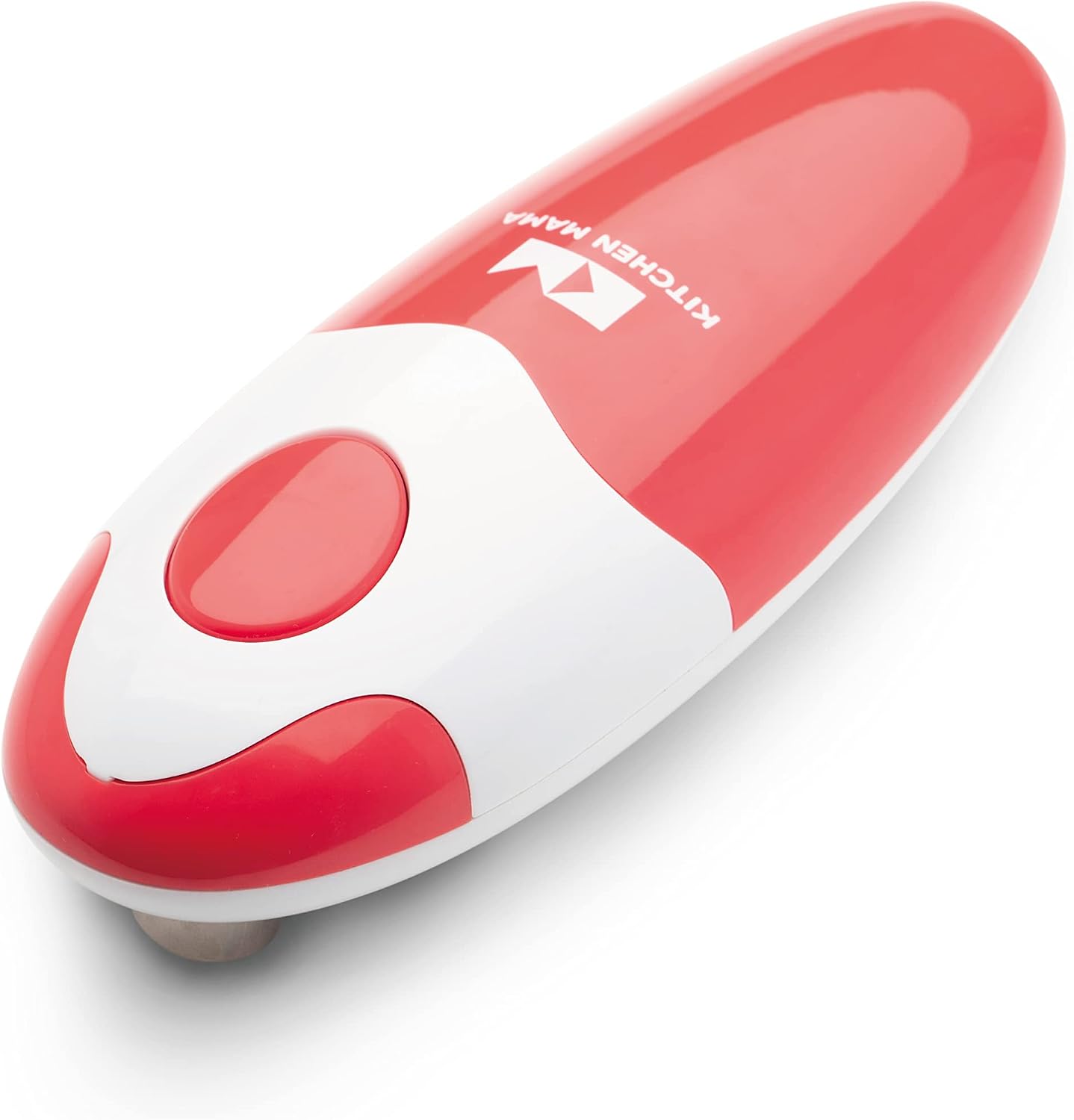
The currently documented US Kitchen Mama Auto 1.0 and Auto 2.0 examples require a button press to start and another press to stop. Do not interpret “Auto” in the name as proof that either one senses a complete cut and shuts itself off.
Other Kitchen Mama models may use different controls. If automatic stopping is the feature you need, verify it on the exact model’s current instructions and selected offer. A feature shown in a family comparison chart or a video of another opener is not enough.
Our catalog includes the red Auto 1.0 and navy Auto 2.0 as separate products. This guide does not transfer the newer model’s lid-removal design or can-compatibility claims to the earlier one.
Check the cans you actually open
Take note of the cans used most often, including rim shape and any unusual format. Kitchen Mama’s compatibility guidance distinguishes regular rims from the slanted- and soda-can uses described for selected newer models. That is not a promise that every opener works with every can.
A smooth-edge claim also is not permission to run fingers along a newly cut edge. Use the intended lid-handling method and treat cut metal cautiously. We have not inspected the edges produced by these tools or tested injury-prevention claims.
If a particular can is essential to the purchase, ask the manufacturer about that exact format rather than extrapolating from a standard round-can demonstration.
Compare cleaning and the next power change
OXO specifies hand washing for its Smooth Edge opener. Kitchen Mama’s care instructions call for a damp towel and exclude immersion, rinsing under running water and dishwasher cleaning. Do not assume that all handheld kitchen tools can be washed in the same way.
The Auto 1.0 and Auto 2.0 product pages specify four AA alkaline batteries, not included. Include the cost and the practical task of replacing them; this is not a rechargeable claim. We have not measured battery life or established a number of cans per set.
The useful comparison is the routine over time: cleaning after use, storing the tool and having the correct power source ready when needed. The manual model avoids batteries but still requires manual operation and care.
Buying for someone else? Ask about the difficult step
Instead of choosing a medical-condition label such as “best for arthritis,” ask what the person finds difficult: holding, cranking, placing, pressing, lifting or cleaning. This guide cannot establish individual medical suitability. A return option matters when real handling is uncertain.
- Verify exact model and start/stop behavior.
- Check the cans, power source and cleaning routine.
- Confirm the recipient can manage the remaining steps.
- Do not replace an opener that already works well merely for a motor.
Compare the OXO Smooth Edge review, Kitchen Mama Auto 1.0 review and Auto 2.0 review.
Common buying questions
Do these Kitchen Mama examples stop automatically?
The currently documented US Auto 1.0 and Auto 2.0 examples require a second button press to stop. Confirm the delivered model rather than treating the family name as a feature list.
Can the electric opener go in the dishwasher?
Kitchen Mama’s instructions exclude dishwasher cleaning, immersion and running-water rinsing. They call for a damp towel; the manual OXO model instead specifies hand washing.
Is an electric opener always easier to use?
That is not established here. Removing cranking can help with one step, but positioning, buttons, lid handling, cleaning and battery replacement still need to suit the user.
Sources and research limits
This is a comparison of documented controls, power and care, not a hands-on opening test. We have not tested opening speed, battery endurance, universal can fit, edge safety or individual ease of use. Manufacturer descriptions do not establish a health or injury-prevention benefit.
Sources: OXO: Smooth Edge Can Opener; Kitchen Mama: Auto 1.0 CO1100-R; Kitchen Mama: Auto 2.0 CO1150-N; Kitchen Mama: can-compatibility guidance; Kitchen Mama: electric-opener care.