
Research checked October 17, 2026. Research-based, not hands-on tested. Linked product reviews contain affiliate links. Affiliate disclosure and image credits.
Quick answer
A travel plug adapter changes the physical connection; an ordinary adapter does not change the mains voltage or frequency supplied to an AC appliance. A voltage converter is designed to change voltage, but it is not a universal fix for a device that cannot use the destination supply.
Before buying either, check the exact appliance’s input label and instructions. Then check the destination supply, the actual socket, grounding needs and all load restrictions. A plug fitting into a socket is only one part of compatibility.
Read the appliance label before the adapter box
Find the input information on the appliance or its supplied power adapter, not just a retailer headline. An input range such as 100–240 V identifies a voltage range; it does not by itself settle frequency, grounding, plug fit or the manufacturer’s travel restrictions. Some dual-voltage appliances require a setting change according to their instructions.
For a charger, distinguish its AC input from its USB or other low-voltage output. The number describing what it sends to a phone is not the mains voltage it accepts. If the label is unreadable or you cannot reconcile it with the destination supply, resolve that with the manufacturer rather than experimenting.
Check the outlet at the accommodation, not only a country-coverage claim on a package. Destinations can have mixed socket standards, and the adapter you pack must match the actual connection you will use.
Why a converter is not an automatic recommendation
A converter would need to be appropriate for both the supply and the exact appliance, including its manufacturer’s restrictions. The REVLON One-Step Volumizer Plus operating instructions explicitly prohibit use with a voltage converter. A generic shopping tip to “add a converter” does not override that warning.
This guide therefore does not recommend a converter for the Revlon example. If your appliance is incompatible or the documentation rules out the proposed setup, consider a manufacturer-approved destination-compatible appliance or ask the accommodation what suitable equipment is available. Do not improvise around a warning.
The exact regional model matters. This article does not infer a numerical mains rating from another country’s Revlon product or assume every item called One-Step has the same electrical design.
Grounding and load limits are separate checks
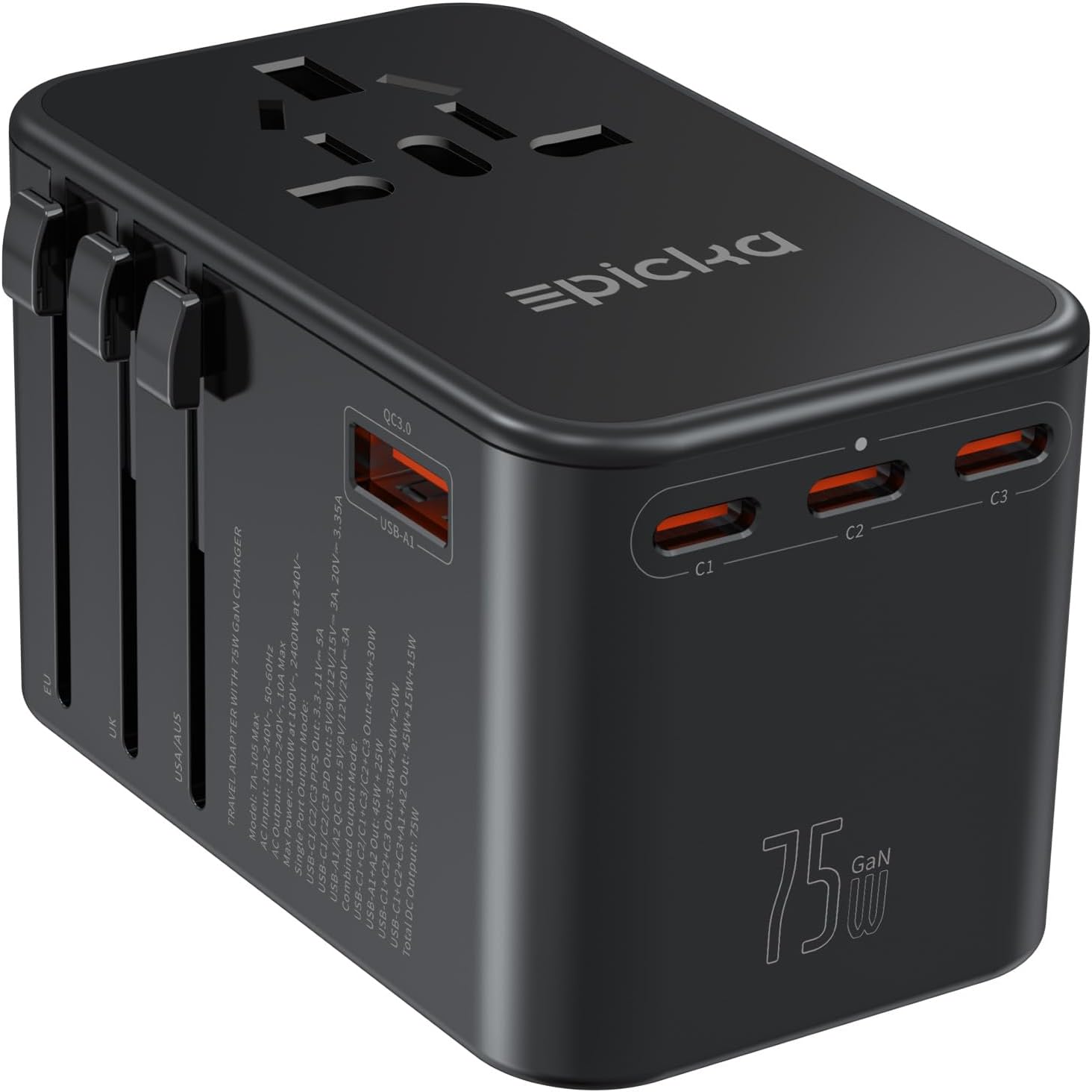
The EPICKA TA-105 Max manual says it provides no voltage conversion and must not be used for grounded equipment. Its multi-format AC socket can physically accept some plugs without supplying the protective-earth path an appliance requires. Do not use it for equipment that needs grounding.
The current manual also excludes Dyson products and appliances above 1600 W even if they are dual-voltage. These restrictions are not erased by a higher-looking number elsewhere on a label. Follow the delivered unit’s instructions and all lower applicable limits; do not borrow ratings from a different TA-105 generation.
Electrical Safety First likewise separates voltage, earth continuity and maximum load in its travel-adaptor advice. We have not electrically tested this adapter or established universal destination approval.
USB charging is not the AC passthrough rating
The pictured adapter combines an AC socket with USB charging electronics. Its 75 W USB headline is a shared charging figure, not a claim that the AC socket converts a hair dryer’s mains voltage. USB device compatibility and available power must be considered separately from the AC appliance connected through the socket.
If you are only charging a phone, assess the phone, cable, supported charging mode and the adapter’s relevant USB limits. If you are powering an AC appliance, return to its input, grounding and load checks. Combining both jobs into one case does not remove either set of requirements.
A pre-packing checklist
- Identify the exact appliance and regional version.
- Match its stated input and instructions to the destination supply.
- Confirm the actual socket and whether protective earth is required.
- Check the adapter’s load limits and explicit exclusions.
- Stop if the manufacturer forbids a converter or the setup remains uncertain.
Our EPICKA TA-105 Max review and REVLON One-Step Volumizer Plus review cover the catalog examples. For the separate styling-workflow decision, see heated brush versus hair-dryer brush.
Common buying questions
Does a plug adapter change 230 V into 120 V?
An ordinary plug adapter does not convert mains voltage. The AC appliance must already accept the destination supply unless a specifically suitable, manufacturer-permitted conversion setup is established.
Is a three-pin socket proof of grounding?
No. The TA-105 Max does not supply protective earth and must not be used for equipment requiring it, even if the plug physically fits.
Can I solve the Revlon example with a converter?
Not according to the checked One-Step Volumizer Plus instructions, which prohibit converter use. Choose a permitted destination-compatible alternative rather than overriding that warning.
Sources and research limits
This is a compatibility checklist based on published safety and operating guidance, not electrical testing, wiring advice or a converter recommendation. We have not verified every destination, socket, appliance revision or travel restriction. Product warnings and the instructions supplied with the exact unit take priority over broad category descriptions.
Sources: EPICKA: TA-105 Max user manual; REVLON: operating and safety instructions; Electrical Safety First: travel adaptors.