
Verdict: a useful screening tool with important limits
The Klein ET140 is worth considering when you want to compare suspicious areas of a wall or piece of wood without making probe holes. Its best role is helping decide where to investigate next. Buy it if you can work with comparative readings and the documented material modes; do not buy it expecting a definitive leak location or an all-clear for an entire wall cavity.
This review covers ET140, Amazon ASIN B07SZX8QXH. It is based on manufacturer documentation and listing verification, without hands-on accuracy testing. A number on a screen can appear more conclusive than it is: drywall and masonry readings are explicitly relative, and the specified sensing depth is only up to 3/4 inch.
Reasons to consider it
- No pinholes during scanning
- Four dedicated material modes
- Readable display and LED range indication
- Hold function for awkward viewing
Trade-offs
- Drywall and masonry readings are relative
- Backing material can affect thin-surface readings
- Not a deep wall-cavity inspection
- Not electrically insulated
Sources: Klein Tools: ET140 product specifications, Amazon: ET140, ASIN B07SZX8QXH, Klein Tools: ET140 instruction manual.
Facts: understand the scale before the number
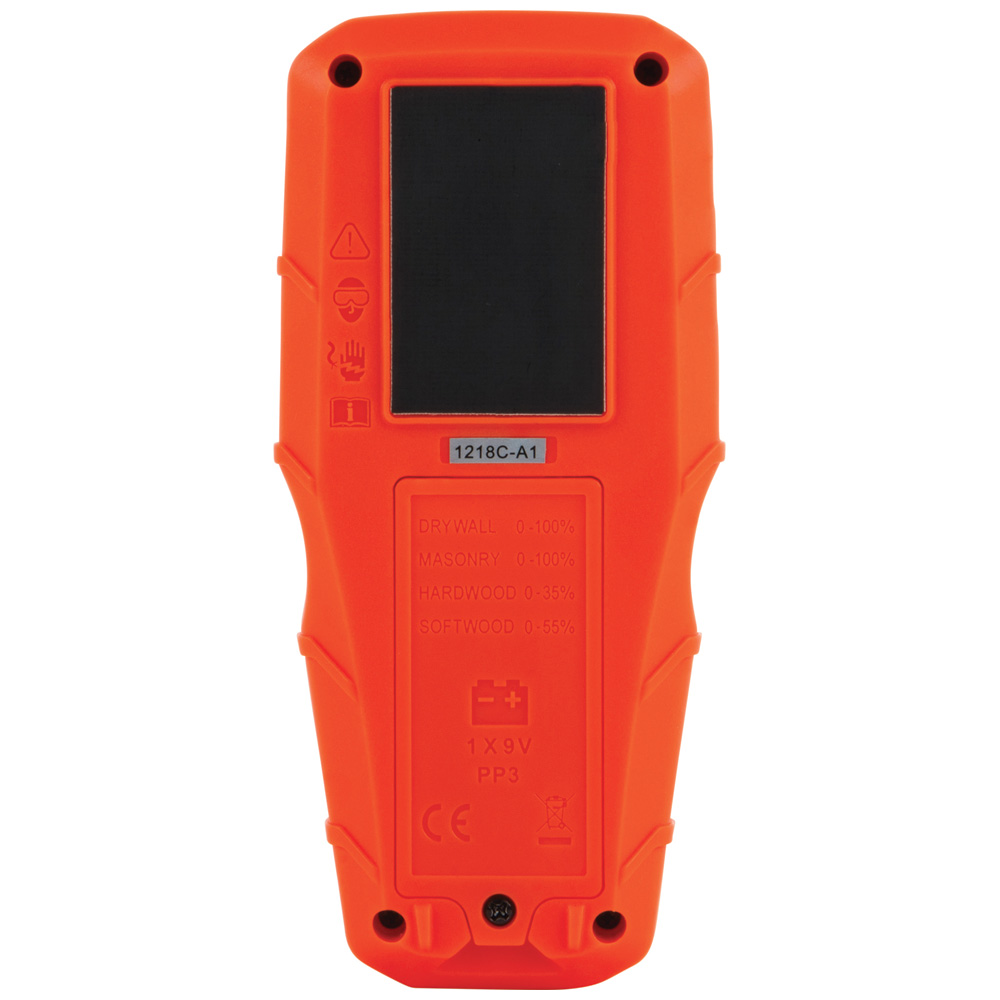
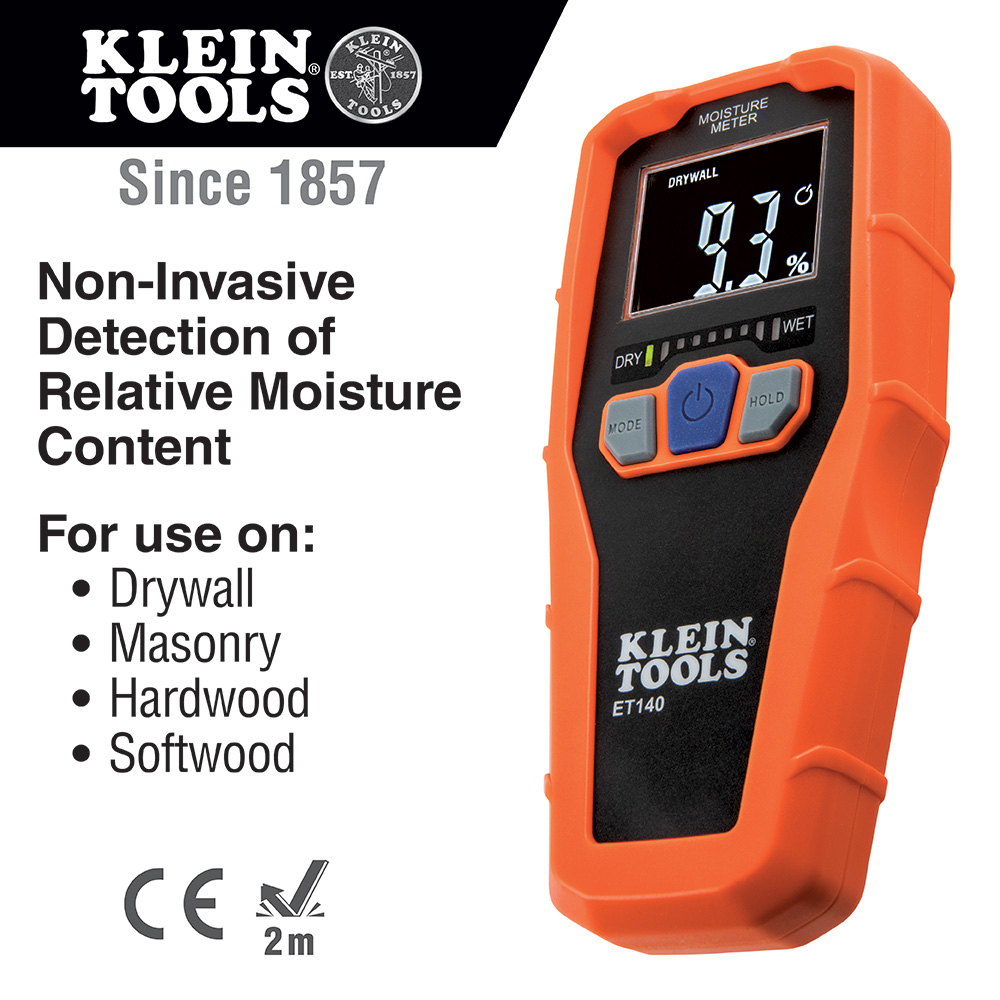
The meter provides drywall, masonry, hardwood and softwood modes. Klein specifies hardwood readings from 0–35%, softwood from 0–55%, and a 0–100 relative scale for drywall and masonry. Its manual gives wood accuracy as ±4%; it does not extend that accuracy claim to drywall or masonry.
A 0.1% display resolution describes the size of the displayed step, not a promise of 0.1% accuracy. The ET140 runs on one included 9V battery. Its approximate dimensions are 6 × 2.5 × 1 inches. These specifications describe the tool, not an independently verified performance result.
| Model / ASIN | ET140 / B07SZX8QXH |
|---|---|
| Measurement method | Pinless capacitance-based sensing |
| Materials | Drywall, masonry, hardwood, softwood |
| Sensing depth | Up to 3/4 in (19 mm) |
| Drywall / masonry | 0–100 relative scale |
| Wood ranges | Hardwood 0–35%; softwood 0–55% |
| Power | One 9V battery, included |
Sources: Klein Tools: ET140 instruction manual, Klein Tools: ET140 product specifications.
Features: quick scans and a readable display
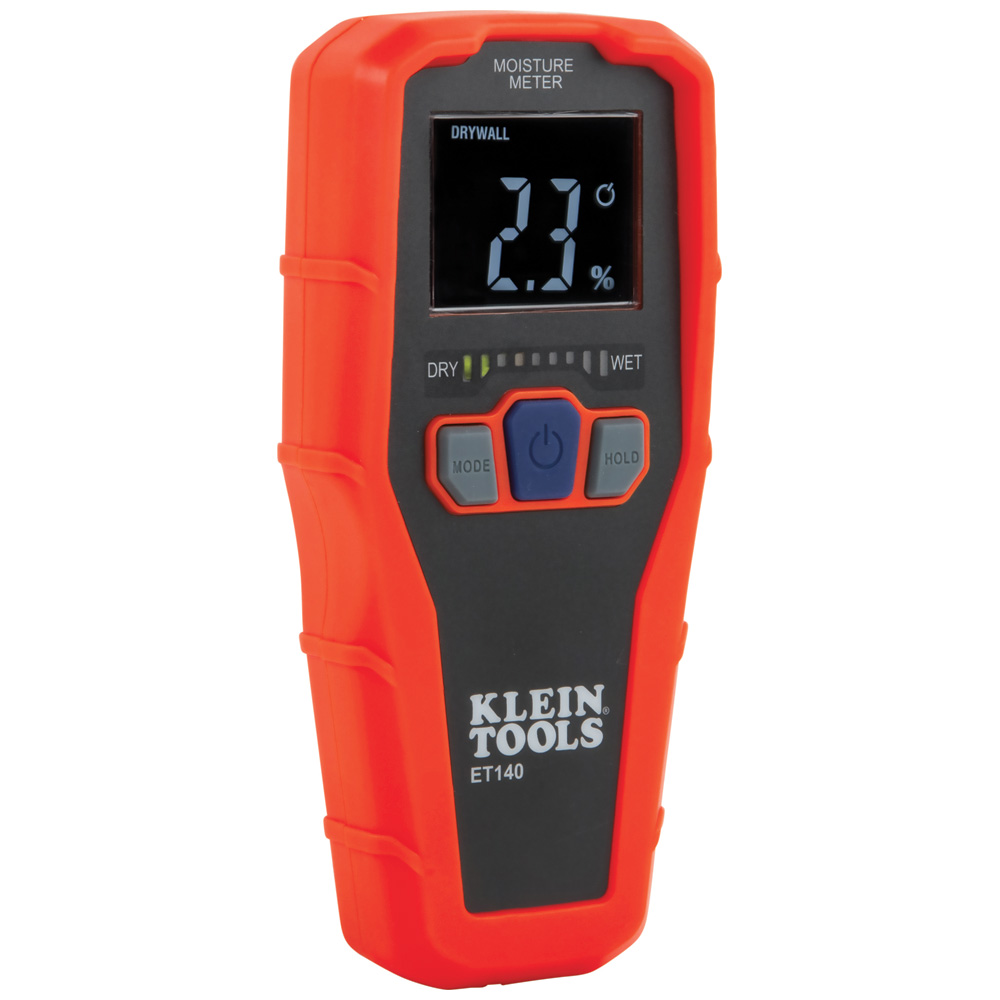
Klein’s reverse-contrast screen and nine-bar LED indicator provide numerical and visual feedback. The mode button selects the material and Hold freezes the reading for easier inspection. Auto power-off and a low-battery indicator help with intermittent use, although the battery still needs replacement when the indicator appears.
The rear sensing area makes contact with the surface rather than puncturing it. This can be convenient for moving across a finished area and comparing nearby positions. It does not eliminate the need to identify the underlying material, use a suitable flat contact area and interpret an unusual result carefully.
Sources: Klein Tools: ET140 design and launch information, Klein Tools: ET140 product specifications, Klein Tools: ET140 instruction manual.
Research: why construction details matter
The manufacturer’s manual explains that material thinner than 3/4 inch can produce a reading influenced by what is behind it. Conversely, moisture beyond the maximum scanning depth is outside the documented reach. Surface-near moisture has a stronger influence than moisture near the depth limit.
Our buying interpretation is to use the ET140 for comparisons within the same kind of construction, then investigate patterns. A reading on one wall should not be treated as directly interchangeable with another wall made from different materials. Record the location and mode if you want repeat checks to be meaningful.
This is also why the meter should not decide an expensive repair by itself. Visible damage, the construction assembly and the suspected moisture source remain relevant. A recurring problem needs its cause investigated; repeatedly scanning the same spot does not fix a leak. We have not validated detection on tiled assemblies, multilayer walls or every wood species.
Sources: Klein Tools: ET140 instruction manual, Klein Tools: ET140 product specifications.
Safety: never treat it as electrical protection
Klein warns that the ET140 is not insulated and should not be used on or near live electrical circuits. Avoid contact with areas that may contain energized conductive parts. A moisture reading provides no information that makes drilling, opening a wall or touching wet electrical equipment safe.
Follow the supplied instructions, including approved eye protection and keeping the battery cover secured during use. The documented operating range is 50–104°F in non-condensing conditions. Protect the meter itself from unsuitable storage or exposure and clean its sensor only as instructed. For unsafe access or suspected energized wet areas, stop and obtain appropriate professional help.
Sources: Klein Tools: ET140 product specifications, Klein Tools: ET140 instruction manual.
Buying: choose screening or diagnosis deliberately
Check ET140 and ASIN B07SZX8QXH before ordering, along with the included battery, seller, condition and return terms. Ask whether you need non-destructive screening or a different measurement method for a specific material. A pinless meter can be a practical first tool, but suitability depends on the question you need answered.
Choose this model for straightforward comparative checks in its four documented modes. Consider specialist advice or equipment when the measurement will determine flooring acceptance, structural work or a costly remediation decision. The Amazon link shows the current offer; this article does not promise a live price or stock status.
Sources: Amazon: ET140, ASIN B07SZX8QXH, Klein Tools: ET140 instruction manual, Klein Tools: ET140 product specifications.
Related buying research
These reviews distinguish leak alerts from moisture readings when checking a possible water problem.
Questions: interpreting ET140 readings
Does 70 on drywall mean 70% water?
No. Drywall and masonry use a relative scale. Do not interpret the displayed number as a laboratory water-content measurement.
Can it see deep inside a wall?
Its documented sensing depth is up to 3/4 inch. It cannot establish the condition of the entire wall cavity.
Why do readings change over thin panels?
The manual warns that backing material can influence readings when the tested layer is thinner than the sensing depth.
Will it leave holes?
The pinless sensor does not use penetrating probes. Follow the contact and handling instructions for the surface.
Does it detect mold or identify the leak source?
No such diagnostic function is established by its moisture-sensing specifications. Use a concerning pattern as a reason for further investigation.
Sources: Klein Tools: ET140 instruction manual, Klein Tools: ET140 product specifications.
Sources and limitations
Research checked October 11, 2026. We checked the exact product identity against the primary sources below. Published specifications and seller imagery are not independent performance tests.
Sources: Klein Tools: ET140 product specifications, Amazon: ET140, ASIN B07SZX8QXH, Klein Tools: ET140 instruction manual, Klein Tools: ET140 design and launch information.
Four genuine Klein Tools images show the meter, rear sensor and manufacturer demonstrations. Display values are illustrative, not measurements from our testing or a diagnosis of the pictured area. Public-use image licensing remains unverified. Image-use disclosure.
Is this a hands-on review?
No. We have not measured performance, handling or durability. Product-specific evidence limits appear in the Research section.
Are these affiliate links?
Purchases through our retailer links may earn a commission. Disclosure and reader-rating privacy.
Image sources and context
- Klein’s ET140 product photo. Displayed values are illustrative, not readings from our testing. Image provenance: media.kleintools.io
- The rear sensing area contacts the tested surface without pins. Image provenance: media.kleintools.io
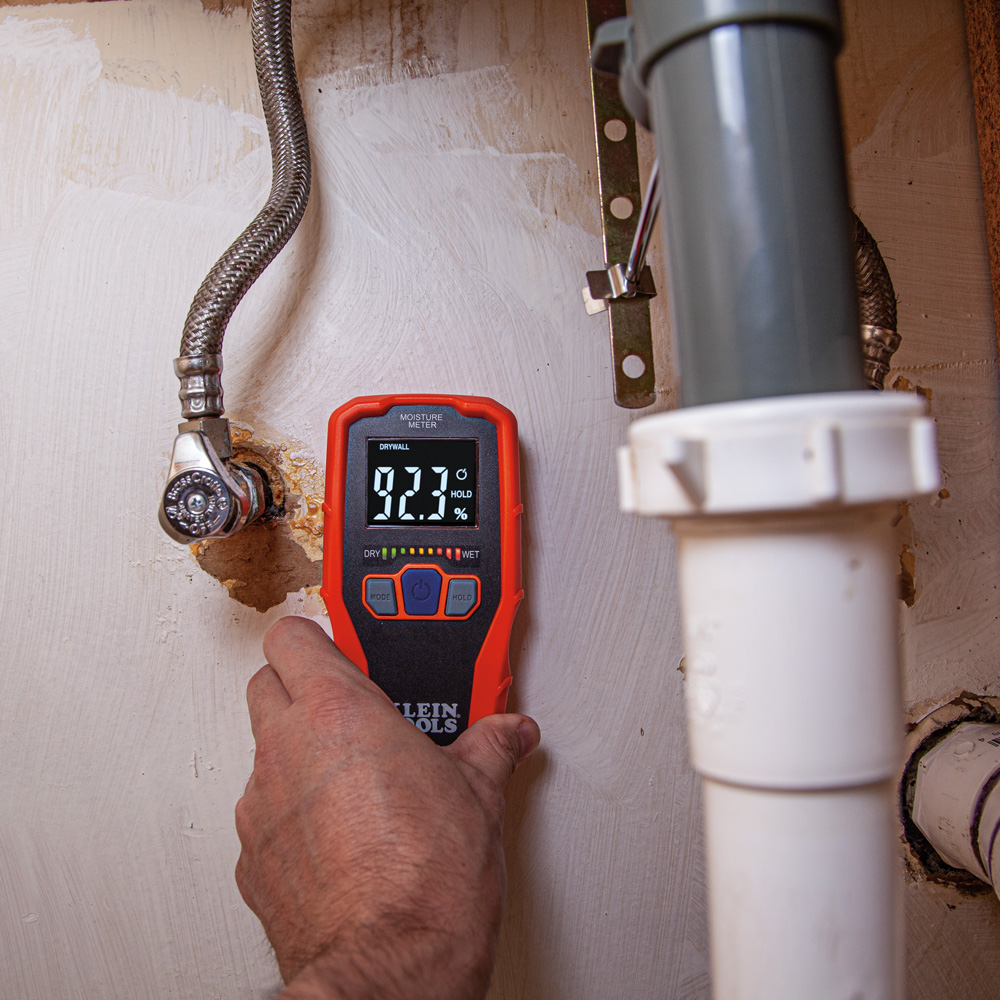
- Manufacturer demonstration. Drywall readings use a relative scale; this photograph does not establish a diagnosis. Image provenance: media.kleintools.io
- The four documented material modes. Marketing image supplied by Klein Tools. Image provenance: media.kleintools.io